

















Philippine Embassy Receives NOH Japanese Theater Master
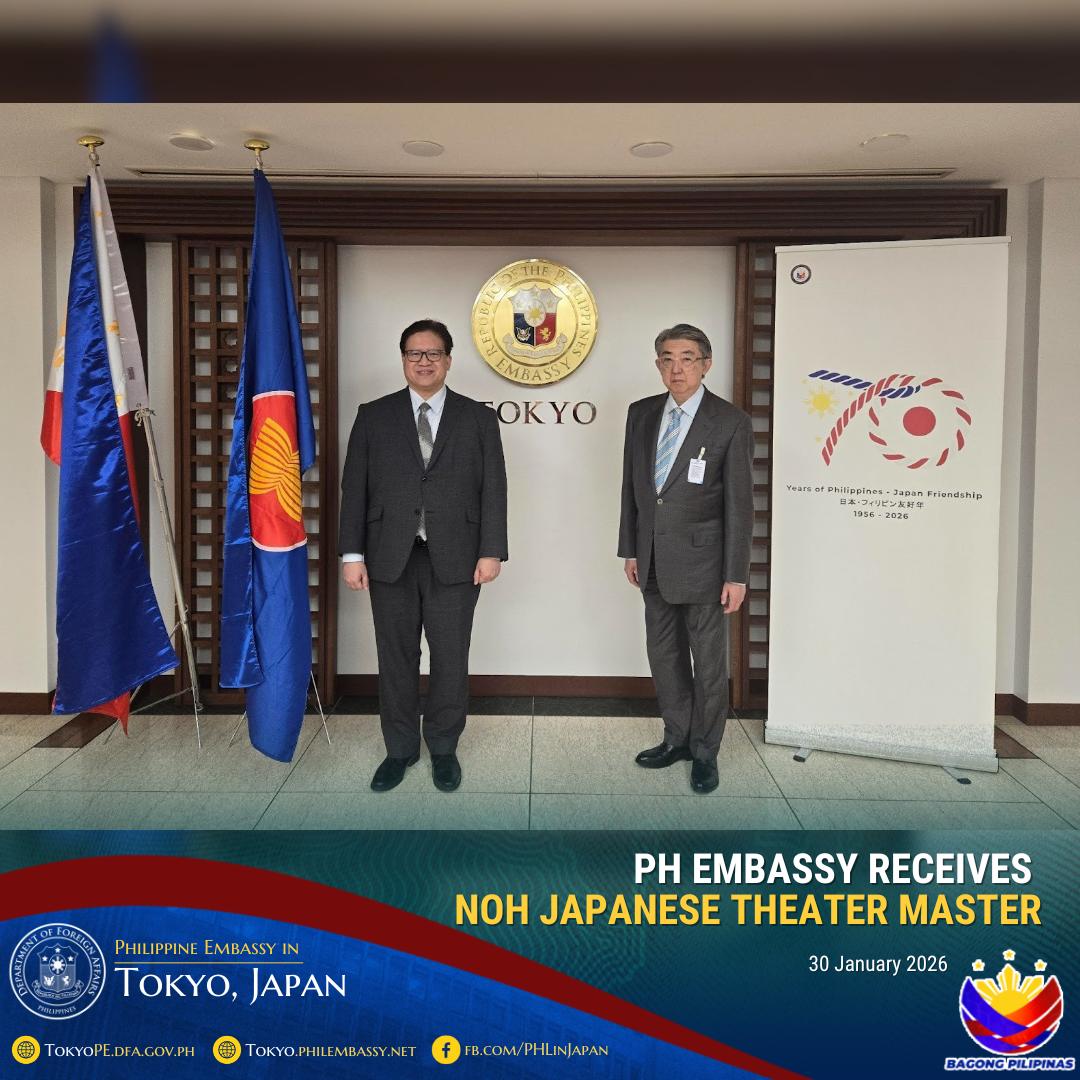
Philippine Embassy in Japan Deputy Chief of Mission Christian L. De Jesus represented the Embassy during the courtesy call of Noh master, Umewaka Chozaemon Sensei on 30 January 2026.
TOKYO, 07 February 2026 – The Philippine Embassy in Japan, represented by Deputy Chief of Mission Christian L. De Jesus, welcomed Noh master Chouzaemon UMEWAKA (also known as Chozaemon Sensei) during a courtesy call at the Embassy on 30 January 2026.
Chozaemon Sensei shared details of his upcoming collaboration with the University of the Philippines – Center for International Studies, the Embassy of Japan in Manila and Japan Foundation-Manila for a Noh theater performance in December 2026 in Manila, Philippines to be held in celebration of the 70th Anniversary of the Normalization of Philippines-Japan Diplomatic Relations.
“The Embassy is honored to welcome Chozaemon Sensei at the Embassy. As one of the pillars of Noh, an embodiment of Japanese culture, bearing the designation of ‘Important Intangible Cultural Property for Noh Theater’, we greatly appreciate his commitment to strengthening people-to-people ties between the Philippines and Japan through performing arts. This is especially significant as we celebrate our two countries’ milestone anniversary this year,” Philippine Ambassador to Japan Mylene J. Garcia-Albano stated following the courtesy call.
Chozaemon Sensei also spoke of his longstanding partnership with UP-CIS on training Filipino students in Noh theater. He expressed his admiration for their talent and dedication in learning one of Japan’s intangible cultural heritage.
Deputy Chief of Mission De Jesus further underscored that Chozaemon Sensei’s cooperation with UP-CIS is testament to the depth and vibrancy of the cultural exchanges between the Philippines and Japan, and reaffirmed the Embassy’s commitment to supporting initiatives that meaningfully contribute to the celebration of the 70th anniversary in 2026.
Noh is one of the traditional styles of Japanese theater combining dance, music, and drama, with origins dating back to the 1300s. It is known for its use of masks worn by actors during performances, stylized movements and symbolic storytelling.


